Copyright © 2024 Otis Nebula Press. All rights reserved.



Follow Us Learn the Latest Status of All Mannequins
– pop-up ad
Some are merely wounded, awaiting surgery,
others are torn apart, plastery shards and yawning hollownesses.
Some are lost in the system, their mothers
and brothers protesting outside the municipal palace.
According to the authorities
many are non-mannequins, having lost
the right to stand in department stores,
like their mother’s fathers and mother’s father’s mothers.
Things haven’t been the same since the goblins took charge
and the round-ups began.
It was the stillness, their patience, that stood out.
Who would trust, the papers said, the goat in a field of goats
who stands absolutely still?
Many of the mannequins have been disappeared,
of course, and their slender replacements
have no eyes or hair or color in their lips –
their skin is the color of teeth, or of burnt trees.
Some do not even have heads. The population
exchange has been gradual,
and fewer of us ask: where have they gone?
Do they need us? Have they stood for so long, silently, for this?
Have their silent gods forsaken them?
It’s up to us. Scour the desert for places
where they’d been dropped from airplanes.
Fund-raise a project locating the pits where many lie together.
Serene sentinels of the unfinished gesture,
we will compel your remembrance, even
in those hours when the stores are dark.
A Brief History of My Bleeding
Sprayed like ink from an old pen, pooling like tar on a hot roof.
The color of a charred rose.
Fertilizer and paint and sauce and stain, my blood
always finds a way out, to the childhood concrete,
the pillowcase, the shirt front after being punched.
I remember when my wrist was cut, an accident I swear,
and the jetting gout hit the ceiling in pulses.
In my eyes while I drive, once.
It may still stain the 25A shoulder asphalt, where passersby
might have assumed for decades now a raccoon
had been squished and carted away, leaving a puddle
of herself to rust in the sun.
Today I give blood to strangers, in tidy bags, and leave
unseen amounts on OR linen.
Come and take it from me,
be my red November, when the beaches are
closed with scarlet tides,
feverish as a tubercular girl at sea,
her first voyage, in the days when a poem
could ensnare great gobs of aura
by thinking on steamships and trains and Seamus
Heaney fields, and mountains too reddened by dusk to measure.
I’m getting around to a friend’s death,
stopped by his heart as he drove, and he drove into a tree.
Blood, because it was stopped, it could not move.
What blood there was on the outside of him
is buried now deep with his junk-compacted Acura.
They tell me and I believe them that I
must lose blood, set it loose, there’s too much of it and
it’s too thick, like the news of war and the news of people lost at borders,
thick waves bleeding over the edges.
Come and take it, if we let it flow between us
then maybe the bruises will pink and
the clots of our ambivalence will deliquesce.
Michael Atkinson's first book of poems, One Hundred Children Waiting for a Train (Word Works, 2001), won the Washington Prize. His poems have been in The Threepenny Review, Ontario Review, Crazyhorse, Prairie Schooner, New Letters, Michigan Quarterly Review, Chicago Review, and elsewhere, including the Louise Gluck-edited Best American Poetry 1993. He teaches at Long Island University.
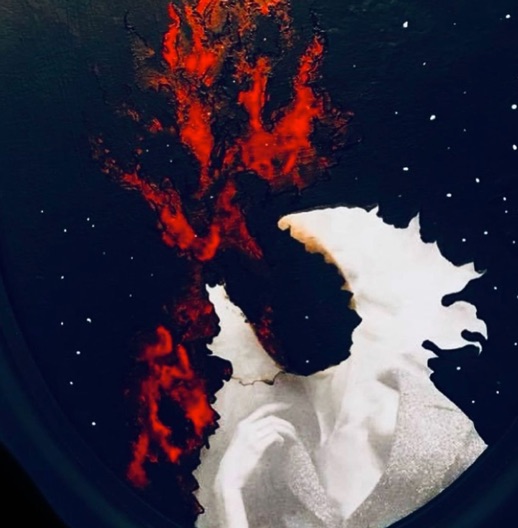
art: Hannah Dobek