Copyright © 2020 Otis Nebula Press. All rights reserved.














The Angel Will Take Off His Hat
Between us two the smoky mirror of a freedom
which we will never understand, from which we come out
and in which we come in as in a water that trembles
and protectively closes behind us.
That flake, lonely and white, always floating between our flights,
our incoherence that at the beginning we were considering it as charm,
the asthenic debility of the hour without contour,
flowing out continuously, to the point of a kind of suffocation ...
Maybe we will never write our names on a real wood,
maybe we will never smile at each other with our souls
totally clean.
Our expectation gives birth to silent flowers in the miraculous space
of moisture, of a possible and glorious fertility,
that is why I am saying to you: understand this love as a round and baked
bread, and hot, from which you can take a steaming piece whenever you want.
Your guardian angel will understand you and he will take off
his hat, once in his eternal life, to cool off in front of the hunger of absolute.
The Season of Leniency
Bring me yet the dogs from the outskirts of the city,
the worthy dogs, lost in the deserted fields,
through clods and mud, dried straw, oil puddles,
to teach them to count the days of life and death,
to lick pieces of old chocolate,
to wonder when their shadow will begin to play the flute
with the eyes black of consuming yearnings.
Like some children to bring them to me,
to throw a white sheet over them, like a shroud
of immaculacy, to rebuke each one
and to make a cross on their forehead.
During this time, hansoms with women giggling of pleasure
will enter into the underground galleries and will disappear
forever, the double of some uncle of mine
will watch me on every corner of the street to tell me
that she, in fact, is not him, and the famous drowned man
from the basin will splash out of the water, shouting that
he has succeeded to hold his breath for another half a century.
I Was Young, I Was Blaring From A Bugle
I was young, I was blaring from a red bugle
on one of the city streets,
beautiful women were passing through in hansom and they
were throwing me flowers,
was the beginning or the end of a century in which
strange things happened,
I was crossing some kind of almost continuous sleep,
a kind of prophetic laziness.
"Look at those black horses, sleeping on the big stone walls”,
I was telling people, "They sleep because they dreamed
too much last night: it was like you had yellow eyes, without pupils,
you were seeing nothing with them and you were surrounded
by a thick smoke, of withered leaves, like a fog, like a permanent
twilight that was holding you the place of air and blood. "
I was blaring from a bugle, leaning on my shoulder
a stick and a bag full of fruit,
from which I was taking a bite at times,
when I was resting and admiring the dry grass
rising up here and there from the cobblestones,
the old gray birds hovering on the low roofs
of the houses and trying to recompose that song
after which, for another century,
no one would touch the earth, but only a kind of
imponderable state, at a palm above any certainty.
Dragoş Niculescu’s work has been published widely in his native Romania. He is also literary critic and cultural editor.
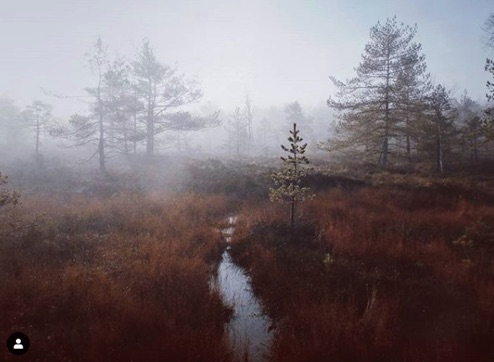

Triin Paja


